More Than a License: The Challenges and Rewards of Building a Nursing Career in Iceland
From Austria to Iceland, with Filipino roots bridging cultures, Cathrine Chalupka-Ho’s nursing career demonstrates that professional migration is far more than a change of workplace.
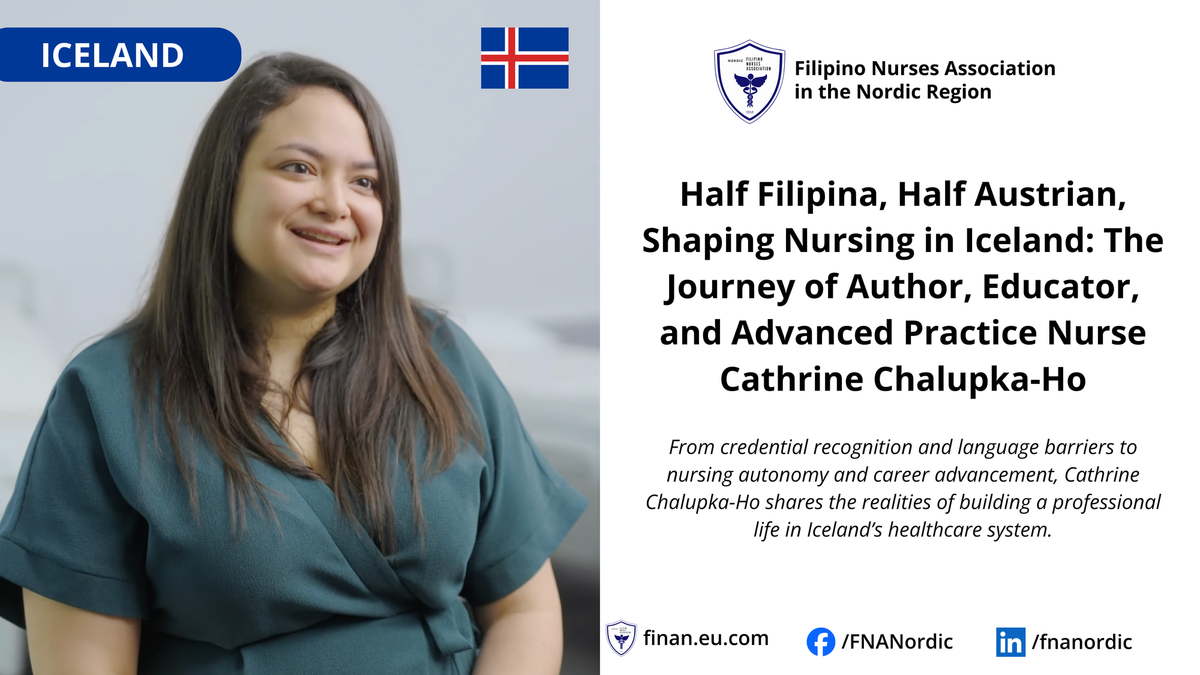
From Austria to Iceland, with Filipino roots bridging cultures, Cathrine Chalupka-Ho’s nursing career demonstrates that professional migration is far more than a change of workplace. It is a journey through bureaucracy, language barriers, cultural adaptation, and continuous professional growth. In this Nordic Puls feature, Cathrine shares the realities of navigating three healthcare worlds and offers practical insights for nurses considering a similar path.
When Recognition Is Not Recognition: The Reality of Licensing in Iceland
For many internationally educated nurses, obtaining a professional license is the first major hurdle. Although Austria and Iceland are both part of the European framework that facilitates mobility, Cathrine quickly discovered that administrative recognition does not always equate to professional recognition.
“Coming from Austria and being an EU citizen definitely helped,” she explains. “There are agreements on the validity of certain educational programmes and, in general, the licensing process itself was not too difficult.”
However, the real challenge began when she sought recognition for her advanced qualifications. Holding two master’s degrees in Advanced Nursing Education and Advanced Nursing Counseling, she found that Iceland did not have direct equivalents for these specializations.
“I had to provide substantial proof that I was specialized. That recognition was important because my qualifications have a significant impact on my salary here in Iceland.”
Another obstacle was navigating communication with the Icelandic Directorate of Health (IDH).
“Depending on who answered the phone or responded to emails, I sometimes received different information. In some cases, it even contradicted what was written on the website.”
The administrative burden was compounded by translation requirements. Documents originally issued in German had to be translated into English or Icelandic, while some also required apostilles—a process that added both cost and delays.
“It was time-consuming, confusing, and complicated. I had to submit additional documents several times because the requirements were not always clear.”
Learning Two Languages at Once
For foreign nurses, language acquisition extends far beyond everyday conversation. Cathrine describes the challenge as learning two languages simultaneously: daily Icelandic and the specialized language of healthcare.
“As an immigrant and healthcare worker, I realized very quickly that I had to learn both.”
Fortunately, immersion accelerated the process. Working full-time from the beginning meant she encountered medical terminology constantly.
“I learned the medical terminology relatively quickly because I was exposed to it every day. Within a few weeks, I could function professionally in my field.”
Interestingly, her German-speaking background proved advantageous during the initial stages.
“German and Icelandic share certain linguistic similarities. At the lower proficiency levels, I could often understand the grammar and vocabulary through association.”
However, progress became more difficult at higher levels.
“The logic I relied on at beginner levels no longer works as well. I am currently around B1–B2, and the linguistic complexity increases significantly.”
Patient Safety Comes First
Despite years of experience and growing language proficiency, Cathrine remains highly conscious of the risks associated with communication gaps in healthcare.
“In high-stress situations, I still prefer to use English for the sake of clarity and patient safety.”
This approach reflects a professional philosophy grounded in responsibility.
“If I feel there is a risk that my Icelandic could be misunderstood, I ask a colleague to take over the communication while I assist.”
The same principle influences her career decisions.
“That is one reason why I do not yet feel confident enough to take on charge nurse responsibilities. Patient safety is the highest good in my hands as a nurse.”
Different Systems, Different Expectations
Moving from Austria to Iceland required more than adjusting to a new language. It meant adapting to a fundamentally different healthcare culture.
One positive surprise was staffing.
“In terms of staffing ratios, I actually prefer the Icelandic healthcare system.”
Yet she also encountered limitations that affected clinical practice.
“When I started working in Iceland, I realized that some treatment options were limited. There were situations where I could only partly use my extensive field knowledge and experience.”
In her observation, some treatment pathways remain difficult to implement due to available resources, varying levels of clinical experience, and the broader support systems required after patient discharge.
“It sometimes feels as though the healthcare system and society are not yet equipped to support the full complexity of certain treatments outside the hospital setting.”
Is There a Glass Ceiling?
Career advancement remains one of the most important questions for immigrant healthcare professionals.
Cathrine believes Iceland offers significant opportunities for growth, particularly for highly educated nurses.
“With the right knowledge and language skills, career progression can actually happen faster than in Austria.”
However, she also acknowledges invisible barriers.
‘Glass ceiling’ is actually a very fitting term,” she says. “On paper, there are equal opportunities. In practice, as a foreign healthcare worker, you feel the limits.”
Language remains the single most important factor.
“Language is the key. Professional expertise alone is not enough if you want to reach senior leadership positions.”
Networking also plays a crucial role.
“You need to make your name known and build professional relationships if you want to be seen for promotion.”
Faith, Family, and Sustainable Practice
Healthcare systems around the world continue to struggle with workforce shortages, and Iceland is no exception. Yet Cathrine believes the Icelandic approach offers meaningful protections.
“Healthcare workers are relatively protected from excessive work hours. Shifts generally do not exceed ten hours, and rest periods between shifts are protected by law.”
She credits much of her resilience to personal support systems.
“My family and my faith are my sanctuary and a place of healing.”
Professional support mechanisms are also available.
“We have access to psychologists, counselors, and even clergy.”
Equally important is practical time management.
“The way I recover physically depends largely on how I spend my time after work. And during shifts, preparation is everything. The better prepared I am, the less unnecessary physical strain I experience.”
Advice for Filipino Nurses Considering Iceland
After successfully navigating multiple healthcare systems, what advice would Cathrine offer Filipino nurses arriving in Iceland for the first time?
Her answer is both practical and encouraging.
“Stay flexible and be open to the foreign healthcare system. Be eager to learn the language and dare to think outside the box.”
She encourages nurses to view adaptation as an expansion rather than a replacement of their expertise.
“Extend your repertoire by adding new ways to care without dismissing what you already know.”
Perhaps most importantly, she advises nurses to trust their professional judgment.
“If you feel uncomfortable taking over certain tasks, do not do it until you are ready.”
And for those facing difficult first months:
“Hang in there, because you will definitely get used to the new.”
A Journey Defined by Adaptation
Cathrine Chalupka-Ho’s story is not merely about moving from one country to another. It is about translating expertise across systems, navigating hidden barriers, and redefining professional identity in unfamiliar environments.
Her experience illustrates a lesson familiar to many internationally educated nurses across the Nordic region: the greatest challenge is rarely obtaining a license. It is learning to thrive in a new professional culture while remaining true to the values that made one a nurse in the first place.
For foreign-trained nurses dreaming of a career in Iceland, Cathrine’s message is clear: the path is demanding, but persistence, humility, and a willingness to learn can transform uncertainty into opportunity.
Interview and feature prepared for Nordic Puls, the online publication of the Filipino Nurses Association in the Nordic Region (FiNAN).