
India Contains Nipah Cluster as WHO Confirms Two Healthcare Worker Infections- Rapid Review Shows Nurses Remain Highly Vulnerable
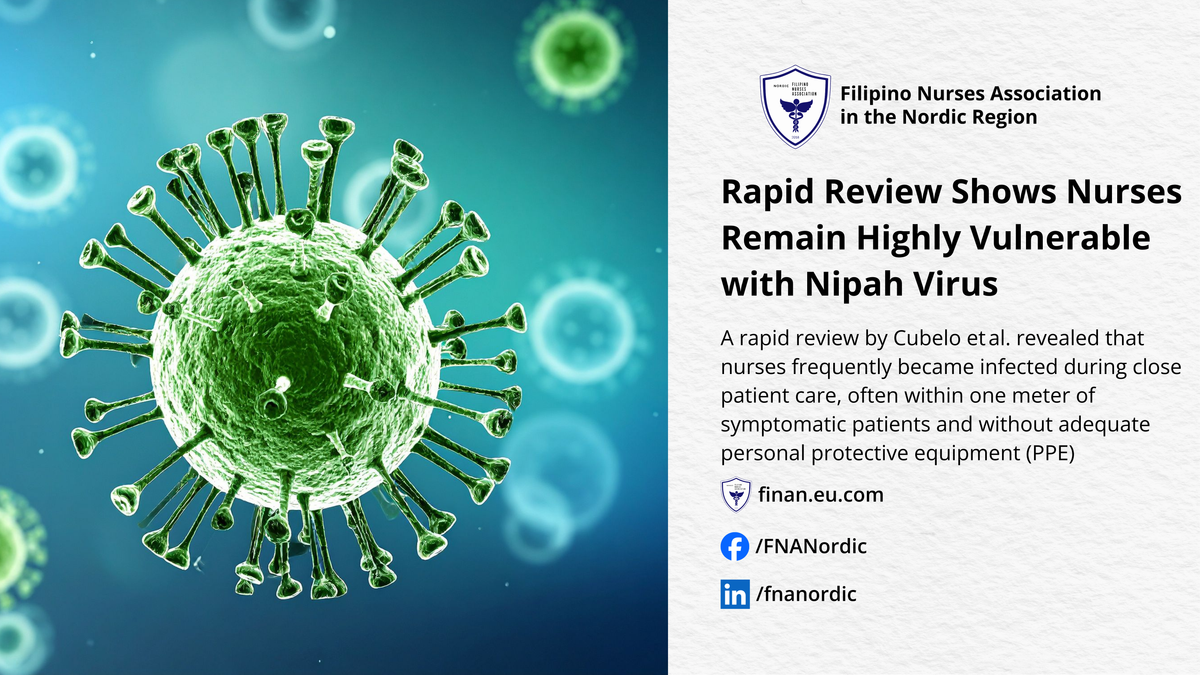
A rapid review by Cubelo et al. revealed that nurses frequently became infected during close patient care, often within one meter of symptomatic patients and without adequate personal protective equipment (PPE)
Indian health authorities report that the recent Nipah virus (NiV) cluster identified in West Bengal has been successfully contained, with only two confirmed cases, both involving nurses, according to updates from the National Centre for Disease Control (NCDC) and the World Health Organization (WHO) (1,2).
Containment Efforts and Case Verification
WHO confirmed that the two cases- both healthcare workers aged in their 20s were diagnosed at the National Institute of Virology (NIV), Pune, with more than 190 contacts tested and all found negative, a finding that supports the containment status of the outbreak (2). Indian public health authorities have reinforced surveillance and emphasized reliance on verified government information, addressing misinformation circulating in media spaces (1).
Kerala’s Updated Guidelines on Treatment and PEP
Kerala’s Department of Health released revised Standard Operating Procedures (SOPs) in 2025, presenting detailed risk‑based guidelines for post‑exposure prophylaxis (PEP), including the use of remdesivir or favipiravir for high‑risk exposures, alongside baseline laboratory and ECG monitoring requirements (3).
Nipah Virus Transmission and Clinical Picture
NiV is a zoonotic pathogen primarily transmitted from fruit bats (Pteropus spp.), contaminated food products, or close human contact. Outbreaks across South Asia have demonstrated high fatality rates between 40–75%, with clinical manifestations ranging from fever and respiratory symptoms to severe encephalitis and coma within 24–48 hours (4,5).
Rapid Review Findings: Nurses Remain Most Exposed Group
A rapid review by Cubelo et al. revealed that nurses frequently became infected during close patient care, often within one meter of symptomatic patients and without adequate personal protective equipment (PPE) (6). The review further identified major gaps in preparedness, including insufficient knowledge of NiV, unclear protocols, PPE shortages, and the psychological burden on frontline nurses- ranging from fear and helplessness to stigmatization within communities (6).
Nurses expressed a strong willingness to receive vaccination, should one become available, highlighting proactive attitudes which policymakers may consider when planning future vaccination campaigns (6).
Ongoing Risk Assessment
WHO currently classifies the risk as moderate at sub‑national level but low at national and global levels, acknowledging India’s rapid containment actions and the absence of further detected cases beyond the initial two nurses (2).
References
- National Centre for Disease Control (India). Nipah Virus Guidelines. 2025. Available from: https://ncdc.mohfw.gov.in/nipah-virus-guidelines/ [ncdc.mohfw.gov.in]
- World Health Organization. Nipah virus disease – India. Disease Outbreak News. 30 Jan 2026. Available from: https://www.who.int/emergencies/disease-outbreak-news/item/2026-DON593 [who.int]
- Government of Kerala, Health & Family Welfare Department. Revised Treatment Guidelines for Nipah Virus Infection. G.O.(Rt)1866/2025/H&FWD. 2025. Available from: https://dhs.kerala.gov.in/wp-content/uploads/2025/07/nipah-revised-guidelines-GO.pdf [dhs.kerala.gov.in]
- World Health Organization. Nipah virus. Fact Sheet. 2018. Available from: https://www.who.int/news-room/fact-sheets/detail/nipah-virus [who.int]
- Centers for Disease Control and Prevention. About Nipah Virus. 2024. Available from: https://www.cdc.gov/nipah-virus/about/index.html [cdc.gov]
- Cubelo F, Kohanová D, Turunen H, Solgajová A, Berdida DJ. Nipah virus and implications for the nursing workforce and public health: A rapid review. Public Health Nurs. 2024;41:1668–1677.